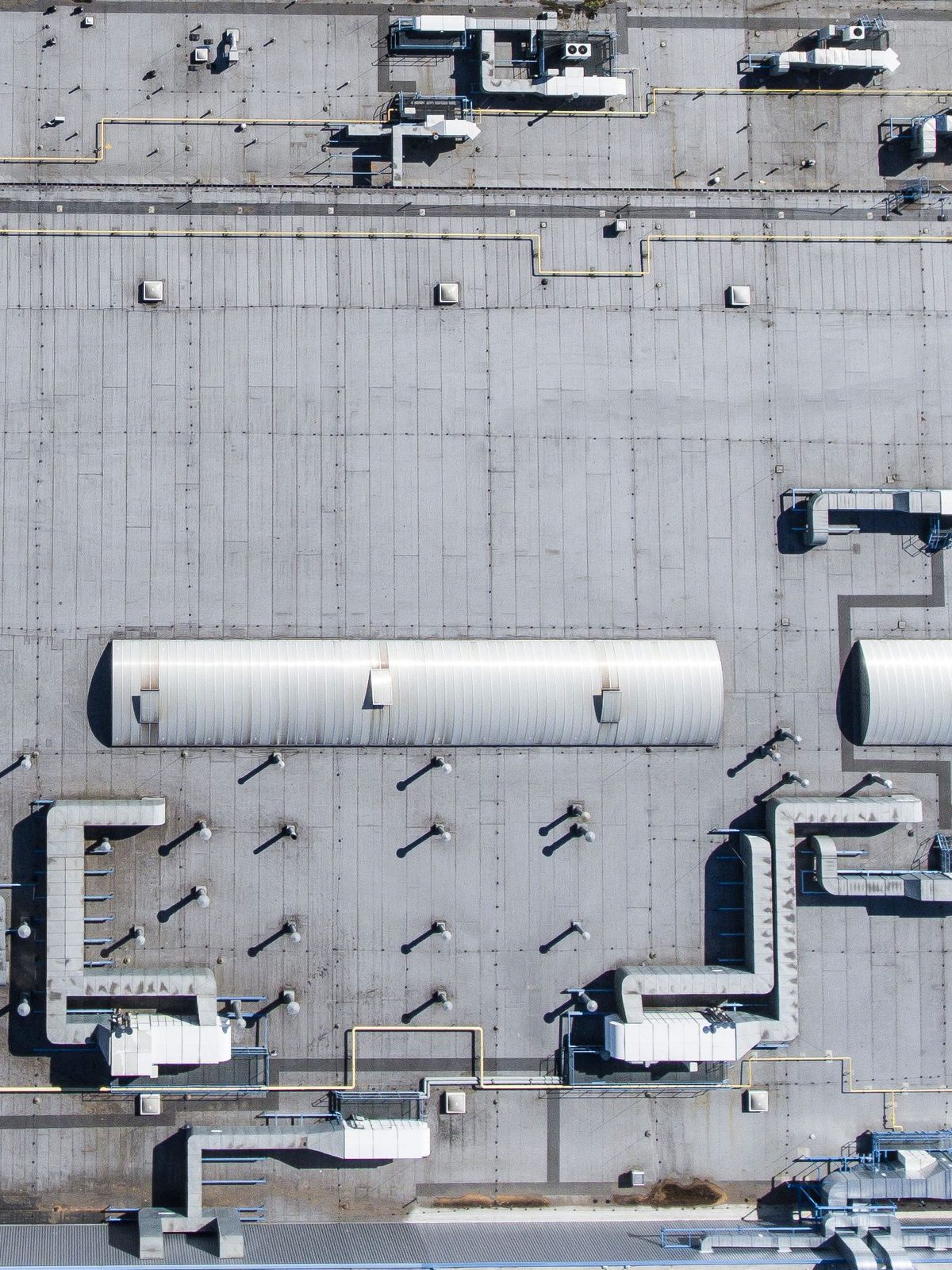
North Las Vegas holds the biggest roofs we inspect. Most of the commercial stock here is warehousing, freight and light manufacturing, covered by wide low slope areas with very little fall and a long way to travel before the water reaches a drain. Around and between those buildings are the newer subdivisions, tract housing put up in programs and roofed in concrete tile.
Acres of membrane, and streets of tile
The two halves of the work here have almost nothing in common.
On an industrial building the roof is most of the building. It is mostly open covering, with the details gathered at the perimeter, along the dock line and around equipment a tenant has added since. Size changes the arithmetic. A small part of a roof this large is a substantial area in its own right, so a fault that would be minor elsewhere turns into a budget line, and anything easy to overlook on one visit can stay overlooked for years.
On the housing side the roofs are newer than most of the valley and were laid tract by tract, so they share an age and a specification street by street. Newer does not mean nothing to find. It means the findings are at the details rather than in the field, because sealants, boots and flashings age on their own schedule whatever year is on the certificate.
Reading a roof that is too big to read by eye
Out in the middle of a roof like this the deck gives a little under load, the fall was never steep, and the drain is distant, so shallow depressions appear in open covering where there is no detail to blame. Water settles in them, softens the material, collects whatever the dust brings with it, and masks whatever lies underneath from anyone trying to survey the roof. So the inspection starts with where the water goes rather than with the membrane: the outlets, the strainers, any overflow provision, and every area still holding water the day after a storm.
After that the perimeter and the dock line, where wind loads the edges hardest and vehicles do damage all year, then the penetrations a later tenant cut in, then the field.
Two tools earn their place on roofs this size. An aerial pass covers the whole area quickly and shows the drainage pattern in one image. A moisture survey records where water is sitting inside the assembly, which turns a very large search into a small one when a leak has appeared inside and nobody can trace it. On a floor packed with racking that is the difference between looking and guessing. Neither replaces walking the roof, and we say in the report which areas were reached and which were not.
Shifts, yards and a city counter of its own
Access here is the easy part. There is usually a yard, room for a ladder or a lift, and a way to get to the building. What there is not is a quiet hour. A building that never stops has no time that suits everybody, so we book around the dock schedule and around whichever aisles can be cleared if anything has to be looked at from below.
On the residential side the constraints are the ordinary ones: a gate unlocked, a dog secured, vehicles moved clear of where a ladder has to stand. If you are buying, tell us the closing date and we will work to it.
The city issues permits for addresses inside its limits, so a repair here is administered by North Las Vegas rather than by the county. The survey itself needs no permit. The work it recommends may, and on a replacement an inspector usually has to view the deck while it is still open. Tell us about the building on the booking form, and see what a commercial inspection includes.
Common questions
Our warehouse roof is too large to walk in one pass. How is it inspected?
In a planned pattern rather than a wander, with the drainage layout as the map. We divide it into areas that relate to something real, usually the drainage zones and the structural bays.
- The order is recorded, so a finding has a location somebody can return to
- Areas covered are stated rather than implied
- First pass follows the water: every outlet, strainer and overflow
- On a wide roof with little fall, water gathers away from any detail
That open covering is where the material gives way first, so standing water goes on the plan. The second pass takes the perimeter, edge metal, dock line and penetrations, and the field comes last. Where the interior cannot be cleared, a moisture survey narrows the ground worth opening, and we will say when that is worth the money.
Can a drone flight replace going on the roof?
No. It does part of the job well and cannot do the rest, so it is worth being clear about which is which before you pay for either.
- A flight photographs a very large roof quickly and shows the drainage layout
- It records standing water and reaches areas unsafe to walk
- It cannot press a soft area or lift a lap to test the bond
- Nor look under a tile, feel a spongy deck or read a curb flashing
Most of what decides repair against replacement is tactile, and the camera has no hands. So we use both: the flight covers ground and finds the areas worth attention, and the walk settles what they are. If a roof is unsafe to walk we say exactly what the report could not confirm.
A previous owner had our North Las Vegas roof coated. Can an inspection tell whether the coating is holding?
Usually, and the more useful question is what is under it. A coating is a surface treatment over an existing roof, and on a sound dry roof that is maintained it does its job.
- Over a roof with water in the assembly it seals that water in
- The material below keeps degrading where nobody can see it
- We can report whether it is bonded or peeling, thin at traffic routes
- And whether it was carried up the details or stopped short
Those findings tell you whether it is due for recoating. What they do not tell you is whether the insulation beneath is dry, and a coated roof hides that better than an uncoated one. Where the history is unknown or anything is stained inside, ask for moisture testing confirmed by a reading rather than an image.
We are buying an industrial building here. What should the roof report settle before we close?
Four things, legible without reading the whole document. What is actually up there, whether the assembly is wet, the condition of the drainage, and the state of the details.
- The system, its apparent age, and whether it has been recovered or coated
- Whether the building has one roof or several of different ages
- Wet insulation is cut out and replaced, and the wet area exceeds the hole
- Perimeter, edge metal, dock canopies and whatever a tenant added later
- Ask the seller for the original roof documents and any warranty paperwork
Wet is the finding that separates a maintenance budget from a capital one, and drainage is the main thing shortening a large roof's life. Each item carries a photograph, a location and a rank, so take the report to a contractor and get the urgent ones priced while the number is still useful.