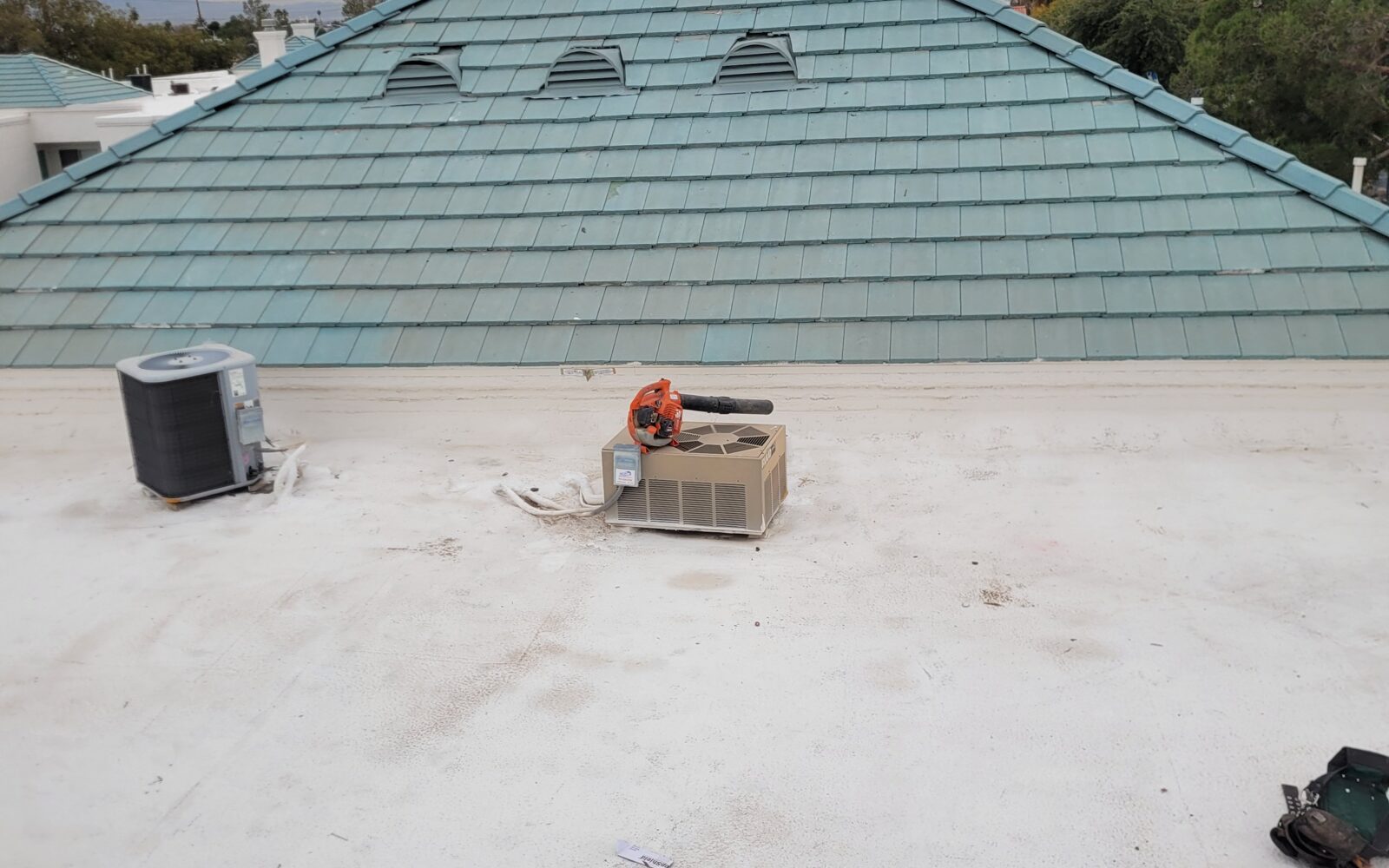
A flat roof is not flat and it does not shed water. It is a low slope roof built with just enough fall to move water to an outlet, and almost everything that goes wrong with one comes back to whether that still works.
So a flat roof inspection starts at the drains, not in the middle.
Drainage first
Drains, scuppers, strainers and overflow paths. Where water goes, how fast it leaves, and every place it sits.
In this climate that one question explains more damage than anything else. Monsoon rain arrives faster than outlets can clear it even when they are clean, and a blocked drain turns a storm into a pond that stays for days. Meanwhile the sun works on the membrane sitting under that water.
Ponding gets measured rather than noted. Depth, extent, and a photograph from a fixed position, so the next visit can say whether it is getting worse. That matters because ponding is progressive: water adds load, the deck deflects, the low spot deepens, and it collects more. A pond that is deeper than it was a year ago is a structural question, not a roofing one, and only a measurement tells you which you have.
Then every detail, one at a time
Flat roofs do not fail in the open field. They fail at the interruptions.
Flashings where the roof meets a wall or parapet. Curbs under every rooftop unit, with four corners each. Pipe boots. Pitch pockets, which are maintenance by design and dry out quietly. Skylights. Drains, where the membrane is clamped and the clamp can loosen without any sign from above.
Each of those is a joint between materials that move at different rates, worked every day by the temperature swing here. An inspection that treats the perimeter as a quick walk has skipped the part that fails.
Seams, equipment and traffic
Seams get probed where the membrane allows it. A lap that has begun to open gives no sign from a distance and plenty of signal to a probe.
The equipment areas get particular attention, because they attract everything: technicians standing and setting tools down, conduit added later by someone who was not a roofer, condensate lines discharging onto the membrane and keeping one area permanently wet. If a flat roof has a worn patch, it is almost always on the route from the access point to the units.
Is the insulation wet
Sometimes the evidence answers it: a soft dished area, blistering, staining inside.
Often it does not, and when a real decision rests on the answer, guessing is expensive. Wet insulation has to come out before anything is laid over it, so the share of the roof that is wet decides whether this is a repair, a recover or a tear off.
That is what an infrared moisture scan is for, and we will tell you when it is worth adding and when the visual evidence already answers the question.
If the roof is tired rather than failing
Not every worn flat roof needs replacing. A sound membrane with a sound deck and reasonable drainage is often a candidate for a coating, which is considerably cheaper.
The conditions matter though, and the big one is that a coating over wet insulation seals the problem in. Whether a coating is the right answer for a tired flat roof covers what has to be true first.
The rhythm
Twice a year, spring and fall, plus a visit after any serious storm. The spring visit is the important one, because it is the one that clears the drains before monsoon season rather than after it.
Between visits, somebody walking the roof after heavy rain to look at the outlets takes minutes and prevents the most common and most damaging problem a flat roof here has.
Next: what a full inspection covers, or commercial roof inspection for a managed building.
Common questions
What is checked on a flat roof inspection?
Drainage first, then every detail individually, then the seams, then the field. Drains, scuppers and low spots come before anything else, because on a low slope roof in this climate water that does not leave causes more damage than any other single factor.
- Drains, scuppers, strainers and overflow paths
- Ponding areas measured for depth and extent
- Flashings, curbs, pipe boots, pitch pockets and skylights
- Seams and laps, probed where the membrane allows
- Equipment areas and the traffic damage around them
The order is deliberate. A flat roof almost never fails in the open field, so an inspection that walks the middle and glances at the perimeter has looked at the least informative part of the roof. The time belongs at the drains and the details, and a report that does not cover both individually has not done the work. It is also why these visits take longer than owners expect, and why a quick one should worry you.
Is standing water on a flat roof a problem?
Water immediately after rain is drainage working. Water still there about two days later, in weather dry enough to evaporate it, is ponding, and that is a defect with a cause worth finding rather than a quirk of the roof.
- The working test is roughly two days in drying conditions
- Ponding adds load, which deepens the low spot
- A deeper low spot holds more water, and so on
- Many warranties exclude or restrict ponding damage
- Causes range from a blocked drain to a deflecting deck
The reason to measure rather than note it is that ponding is progressive. Water adds load, the deck deflects, the low spot deepens and it collects more. A pond that is measurably deeper than it was last year has stopped being a roofing question and become a structural one, and only a dated measurement tells you which you have. Two photographs from the same spot a year apart answer a question nothing else can answer.
Can you tell if the insulation underneath is wet?
Sometimes from the evidence alone: a soft or dished area, staining inside, a membrane that has blistered. Where the question is genuinely open and a real decision rests on it, an infrared moisture scan answers it properly and a visual inspection does not.
- Soft or dished areas suggest crushed or saturated insulation
- Interior staining shows water has reached the deck
- Blistering can indicate trapped moisture below
- None of that measures how much of the roof is wet
- A scan plus core cuts gives the figure
The reason the figure matters is that it decides repair against replacement. Wet insulation has to be removed before anything is laid over it, so a small wet share is cut out as part of a recover while a large one makes a tear off the honest answer. Guessing at that number before a reroof is how owners end up paying twice. The figure is also what makes competing bids comparable, since all of them are then pricing the same roof.
How often should a commercial flat roof be inspected?
Twice a year suits most commercial flat roofs, plus an extra visit after any serious storm. Spring and fall is the usual rhythm here, and of the two the spring visit matters most, because it is the one that clears the drains before monsoon season rather than after it.
- Before summer and after it is the standard pattern
- Add a visit after any storm with real wind or hail
- Clear the drains before the rain, not during it
- Roofs with heavy service traffic earn more attention
- A dated record supports both budgeting and any claim
Between visits, the single most useful habit is someone walking the roof after heavy rain and looking at the drains. It takes minutes, needs no expertise, and catches the problem that causes the most damage here. Blocked outlets are the leading cause of standing water and they are entirely preventable. It is the cheapest preventive habit available on a flat roof and almost nobody does it.
My flat roof leaks but nobody can find where. Why?
Because water travels. It enters at one point, runs between the membrane and the insulation or along the deck, and appears somewhere else entirely. On a large low slope roof the entry point can be a long way from the stain, in any direction.
- The stain is almost never under the hole
- Water moves between layers before it comes through
- Interior access is what connects the two
- Intermittent leaks need the right wind and rain to show
- A moisture map narrows the search dramatically
This is the case where a moisture scan pays for itself fastest. A map saying one quarter of the roof is wet lets the inspection concentrate on the details above that quarter instead of treating the whole roof as equally likely. On a big roof that is the difference between finding the leak and patching hopefully. On a small roof you can afford to search; on a large one you cannot, and that is when the map earns its fee.