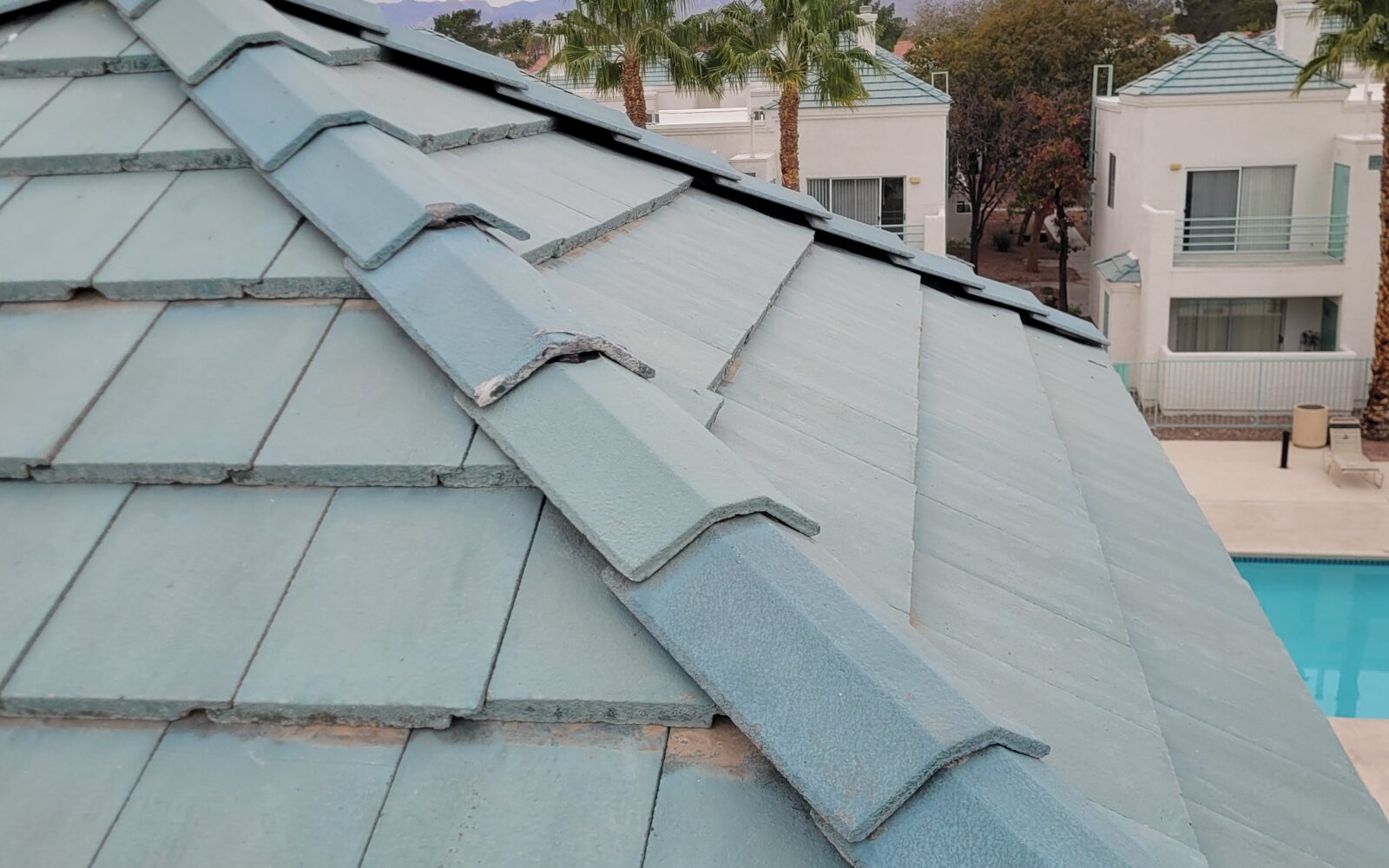
A tile roof inspection from PRS looks at the layer under the tile, because that is the layer keeping water out of your house.
Tiles are a shield. They take the sun, the hail and most of the water, and concrete and clay both last a very long time doing it. Underneath sits the underlayment, and that is the actual waterproofing. In this climate it dries out, shrinks and goes brittle, and it does so decades before the tiles show their age.
Which produces the central problem with tile roofs here: the roof looks fine from the street for years after it has stopped being fine.
What we look at
The underlayment, directly. Tiles lifted in representative places across different roof planes and exposures, so the condition of the waterproofing can actually be seen rather than inferred. This is the part most inspections skip, and it is the part that answers the question.
Valleys. Where tile roofs leak most. Debris collects, water is held against the metal, and corrosion follows.
Flashings. Walls, chimneys, penetrations, vents. These are joints between materials that expand and contract at different rates, every day, in a climate with a large daily swing. They are worked harder here than almost anywhere.
Broken, slipped and missing tile. Each one located. Each is a hole letting ultraviolet straight onto the underlayment, creating a failure in that spot years ahead of the rest of the roof.
Battens and fasteners. What the tile sits on and what holds it. Deterioration here shows as slipped tile long before anything leaks.
Why tiles break
Weather is not the main cause. People are.
Solar installers, satellite fitters, air conditioning technicians and anyone else with a reason to be on the roof. Tile is supported at specific points and has to be walked on specific lines; step in the wrong place and it cracks, often without an obvious sign from above.
The breaks are rarely reported by whoever caused them. They are cheap to fix at the time and expensive to leave, because each one is now an open window onto the underlayment.
If a trade has been on your roof since it was built, say so when you book. We will look specifically where they would have walked.
What the report tells you
Every finding located and photographed, a condition rating, and a view on what the underlayment has left.
That last part is the one that matters for planning. A tile roof with sound underlayment has years of life and needs nothing but repairs. A tile roof with failing underlayment needs the tiles lifted, the underlayment replaced and the tiles relaid, which is a substantial project and worth knowing about before it announces itself through a ceiling.
Telling those two apart is the entire purpose of the visit.
What replacement actually means on a tile roof
Owners often assume a failing tile roof means a new roof. It usually does not mean new tiles.
The normal project is a lift and relay: the tiles come off and are stacked, the old underlayment is stripped, new underlayment and flashings go on, and the same tiles go back. Broken ones are replaced from the stack or matched. The expensive, long lasting part of the roof is reused.
Two things decide whether that is possible. Whether enough of the tile survives handling, which depends on its type, age and how brittle it has become. And whether a close enough match is available for the ones that do not, which is worth checking early on an older or discontinued profile.
It is worth knowing this before anyone quotes you for a complete tear off, because the two are very different numbers and the lift and relay is the usual answer.
The fifteen year prompt
If the roof is more than about fifteen years old and nobody has ever looked under the tiles, book the inspection whether or not anything is wrong.
Not because fifteen years is a deadline. Because it is roughly the point where assuming stops being reasonable, and because the answer changes your budget for the next ten years either way. Finding that the underlayment is sound is worth the fee as much as finding that it is not.
If this is about insurance rather than maintenance, documenting roof age and condition for a policy covers what an insurer will want to see.
Next: what we check on a tile roof in more detail, or book an inspection.
Common questions
Why does a tile roof need inspecting if the tiles look fine?
Because the tiles are not the waterproofing. They are a long lasting shield over an underlayment that does the actual work of keeping water out, and that layer has a far shorter life. A tile roof can look settled from the street and be at the end of its service life.
- Concrete and clay tile last a very long time
- The underlayment beneath them does not
- It dries out, shrinks and becomes brittle in this climate
- None of that is visible without lifting tile
- A broken tile accelerates failure in that spot specifically
This is the single most common misunderstanding about tile roofs here, and it costs people money in both directions. Some replace a roof whose underlayment had years left because tiles were cracked. Others leave a roof alone for a decade past the point of replacement because the tiles still look good from the yard. Only looking underneath settles it.
How do you inspect the underlayment without taking the roof apart?
By lifting tiles in representative places rather than everywhere. A handful of locations chosen across different roof planes and exposures gives a reliable picture of the layer's condition, because underlayment ages fairly evenly except where a broken tile has exposed it.
- Tiles are lifted and replaced, not removed permanently
- Locations are chosen across planes and sun exposures
- Areas under broken tile are checked specifically
- Valleys and flashings are examined at the same time
- We agree how many places before starting
The number of locations is a judgment between cost and confidence, and it is yours to make rather than ours. For a roof you are simply planning around, a few places is enough to tell you where you stand. For a purchase, or a decision about whether to replace, more locations give a firmer answer, and the difference in fee is small measured against the size of the decision it supports.
Where do tile roofs actually leak?
Valleys and flashings, far more often than the field. A metal valley fills with debris or corrodes through, and the wall, chimney and penetration flashings are worked hardest by the daily expansion and contraction this climate delivers every single day of the year.
- Valleys collect debris and hold water against metal
- Wall and chimney flashings move constantly with temperature
- Pipe and vent flashings have a shorter life than the tile
- Anything added after the roof went on is a likely suspect
- The field of a tile roof rarely fails first
This is exactly why an inspection that walks the field and counts broken tiles misses the problem entirely. The time belongs at the valleys, at the junctions with walls and chimneys, and at every penetration through the roof. It is also why a tile roof leak is very often repairable rather than terminal, provided the underlayment beneath it still has life left in it.
Does walking on tile damage it?
It can, easily, and careless footfall breaks more tiles than weather does. Tile is walked on specific lines where it is supported, and anyone on the roof who does not know those lines leaves cracked tiles behind them for somebody else to find.
- Tiles are supported at particular points, not across their span
- A cracked tile may not be obvious from above
- Each break exposes the underlayment to ultraviolet
- Solar and air conditioning crews cause most of this damage
- A rule that trades do not walk the tile is worth having
If you have had solar fitted, satellite equipment installed or air conditioning serviced at any point since the roof went on, that is worth mentioning when you book. Those visits are the most common source of broken tile on a Las Vegas roof, the breaks are very often not reported by whoever caused them, and the damage is cheap to put right now and expensive to leave for five years.
When should I have a tile roof looked at?
Twice a year suits most, plus after any storm with real wind. Beyond that, if the roof is more than about fifteen years old and nobody has ever looked under the tiles, that is the inspection to book regardless of whether anything is leaking.
- Before summer and after it is the usual pattern
- Add a visit after wind, since tile slips rather than tearing
- Over fifteen years old with no underlayment check is the key case
- Before selling, so the roof is documented rather than argued about
- After any trade has been on the roof
The fifteen year mark is a prompt rather than a deadline, and it exists because that is roughly when owners stop being able to assume. A roof whose underlayment is sound at that point is worth knowing about, because it changes what you budget for the next decade just as much as finding the opposite would.