An HOA roof inspection from PRS surveys every roof in the community, rates each building on its own, and produces one ranked list across the whole site. A board can budget from it. A manager can hand it to a contractor. Neither has to be a roofer to read it.
That is the difference from an ordinary inspection. The question an association is answering is not whether the roofs are fine. It is which buildings get this year’s money, and in what order.
Why each building needs its own rating
Communities here are usually built in phases, and phases finish months or years apart. Add a replacement after a storm on one or two buildings, and the spread in roof age across a single community can be ten years.
A single rating for the site hides all of it. Worse, it tends to follow whichever building generated the most complaints, and the loudest roof is very often not the worst one.
Rating each building separately turns a vague worry into a list, and a list is something a board can approve.
What we look at
Drainage. Where water goes on each roof and anywhere it sits. In this climate that single question explains more damage than anything else.
The details. Flashings, valleys, penetrations, vents, skylights, and every junction with a wall or parapet. Roofs fail where the roof stops and something else begins, not in the middle.
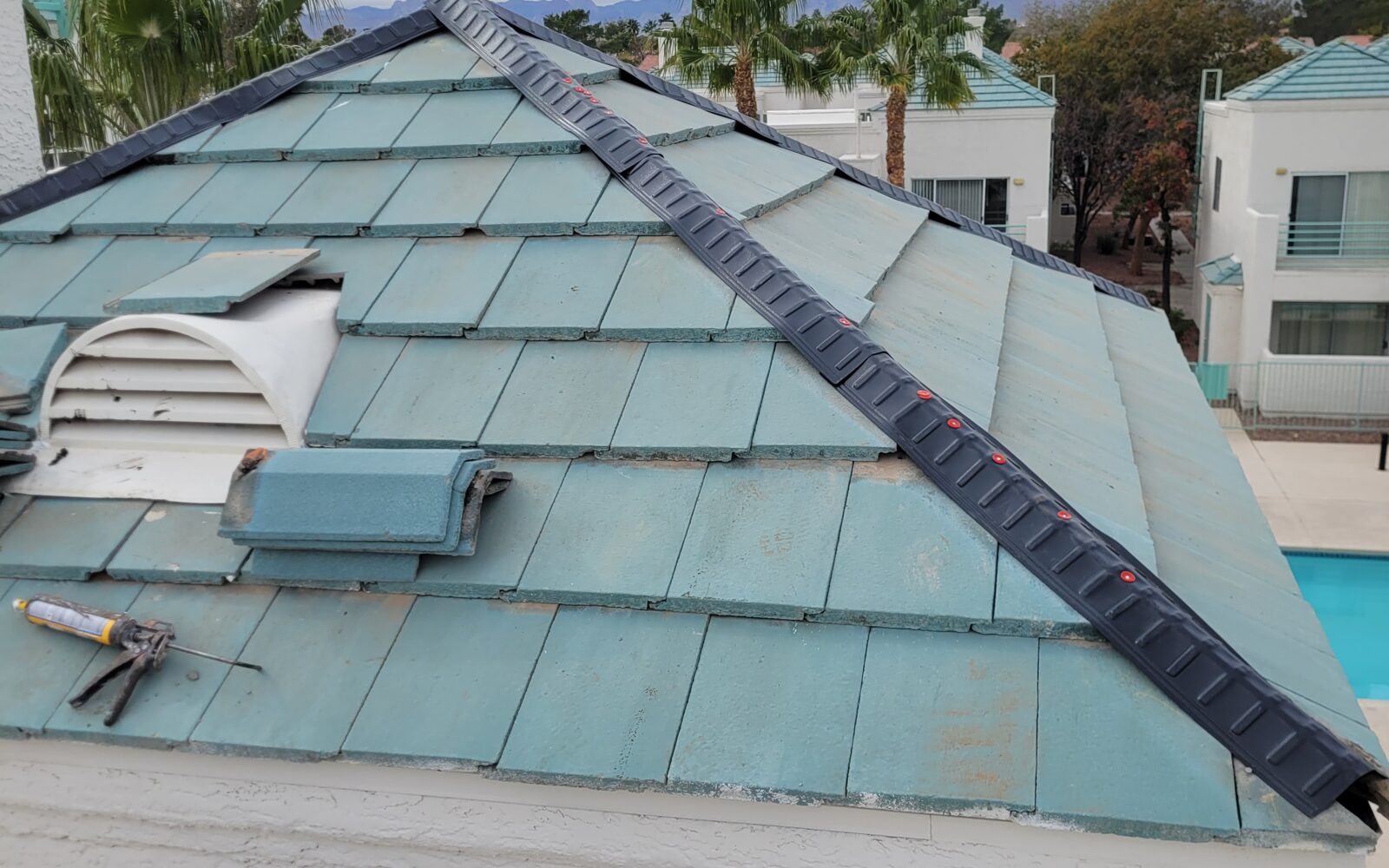
The covering. Cracking, chalking, brittleness, shrinkage, broken or slipped tile, and the marks left by people who have been up there.
Previous repairs. Including the poor ones. A community that has been patched by whoever was cheapest for a decade usually shows it, and that history changes the repair list.
The tile question
A great many Las Vegas communities are tile, and tile has a specific trap. The tile lasts a very long time and looks much the same for decades. The underlayment beneath it, which is the layer actually keeping water out, has a far shorter life and cannot be seen from the ground.
So a community can look settled from the street while its roofs are approaching the end. An inspection that counts broken tiles and stops there has not answered the question. Where it matters, the underlayment has to be looked at directly.
What a board gets
A document per building, with findings in plain language and photographs beside them, each one located on a site plan.
Then one ranked list across the community: what cannot wait, what should happen this year, what can be scheduled, and what is simply age and should be left alone. That last category matters. A survey that recommends work everywhere is not a survey.
If reserve planning is the purpose, say so at the start and we will include an estimate of remaining life per building, which is the figure a reserve specialist needs and a plain condition report does not carry.
Phased replacement, the option boards miss
When several roofs in a community reach the end within a few years of each other, the instinct is to treat it as one enormous project and one enormous assessment. It rarely has to be.
A survey that rates each building separately and estimates remaining life per building lets a board sequence the work: the two worst roofs this year, the next three the year after, the rest when they get there. The total spend is similar. The shape of it is completely different, and so is the conversation with owners.
It also means the community is never in the position of replacing a roof that had four years left simply because it was on the same contract as one that had none.
What it costs
The number of buildings is the main driver, then the roof types, then whether reserve planning is included, then access. Roofs reached over occupied patios or through units need coordination, and coordination takes time.
We will tell you which of those apply to your community before you commit to anything.
Worth knowing before a claim
If a storm goes through, the question an adjuster asks is which damage is new and which was already there. Without a dated survey from before, that is extremely hard to answer and associations routinely lose the argument.
Two surveys a year build that record as a by product of work you were doing anyway. It is also worth understanding what an association policy usually covers on a roof before you need to find out.
Tell us how many buildings, roughly when they were built, and what the roofs are, and we will come back with a scope and a date. The areas we cover spans the valley and beyond it.
Common questions
What does an HOA roof inspection cover?
Every roof in the community, rated separately rather than as one site. Drainage, flashings and details, the covering itself, and whatever rooftop equipment or previous repairs have done to it. The output is a document for each building plus one ranked list across the whole community.
- Each building gets its own condition rating
- Findings are photographed and located on a site plan
- Drainage and details are examined before the open field
- Previous repairs are recorded, including the poor ones
- The ranked list spans the community, not one building
One rating for a whole community is close to useless to a board, because the entire point of the exercise is deciding which roofs get this year's money and which can wait. Communities built in phases routinely carry a five or ten year spread in roof age across them, and the buildings that genuinely need attention first are rarely the ones residents complain about loudest.
How often should an association inspect its roofs?
Twice a year suits most communities here, plus a survey after any serious storm. Heat and ultraviolet work on these roofs through every summer, and monsoon wind and rain arrive in short hard bursts that find whatever was already weak.
- Before summer and after it is the usual rhythm
- Add a survey after any storm with real wind or hail
- A dated record supports both reserve planning and any claim
- Communities approaching replacement age earn closer attention
- Between surveys, a manager walking the roofs costs nothing
The dated record is worth more to an association than to almost anyone else, for two separate reasons. Reserve studies rest on remaining life estimates, and estimates backed by a documented history are far easier to defend to owners who are being asked to fund them. And when a storm claim is assessed, the question is always which part was damage and which part was wear, and that is close to unanswerable without a before.
Can the report be used for a reserve study?
Yes, if you tell us that is what it is for. A reserve oriented survey includes an estimate of remaining life per building alongside the condition rating, which is the figure a reserve specialist needs and a plain condition report does not contain.
- Say at the outset that reserve planning is the purpose
- Remaining life is estimated per building, not per community
- Condition, age, drainage and repair history all feed the estimate
- It is an estimate from evidence, not a guarantee
- The same survey still serves as a repair document
A reserve specialist is not a roofer and should not be guessing at roof life from a walk around the parking lot. Giving them a documented per building assessment is what turns the roofing line of a reserve study from an assumption into something owners can be shown. It also tends to surface the phased replacement option, which is usually cheaper than everything failing at once.
Who should request the inspection, the board or the manager?
Either, and in practice the property manager usually arranges it while the board approves it. What matters more is that whoever receives the report can act on it, which is why the document is written for a non specialist reader.
- We work with managers, boards and owners directly
- One point of contact keeps scheduling simple
- Access to occupied areas is arranged in advance
- The report is written to be read without a roofer present
- We will present the findings to a board if that helps
The common failure here is a survey that arrives as a technical document nobody on the board can interpret, gets tabled for a later meeting, and is still sitting unactioned when the next storm arrives. Writing the findings plainly is not a courtesy or a simplification; it is the thing that decides whether the money gets spent on the right roof at the right time, or not at all.
Do you handle the repairs you find?
PRS does roofing work, and we will tell you plainly where that is the case so you can weigh it. Many associations prefer the inspection to come from one party and competitive bids for the work from several, and the survey is written to support exactly that.
- The report is written so any contractor can quote from it
- Findings are located and photographed, not described vaguely
- That makes bids comparable, which is the point
- A board is free to use the survey and go elsewhere
- We will say when a finding is age rather than a defect
A survey that produces work only its author can price is not a survey, it is a sales document. The test is whether three contractors could bid the same scope from it and return comparable numbers. That is what we write toward, and it is also the easiest thing for a board to check before approving anything.