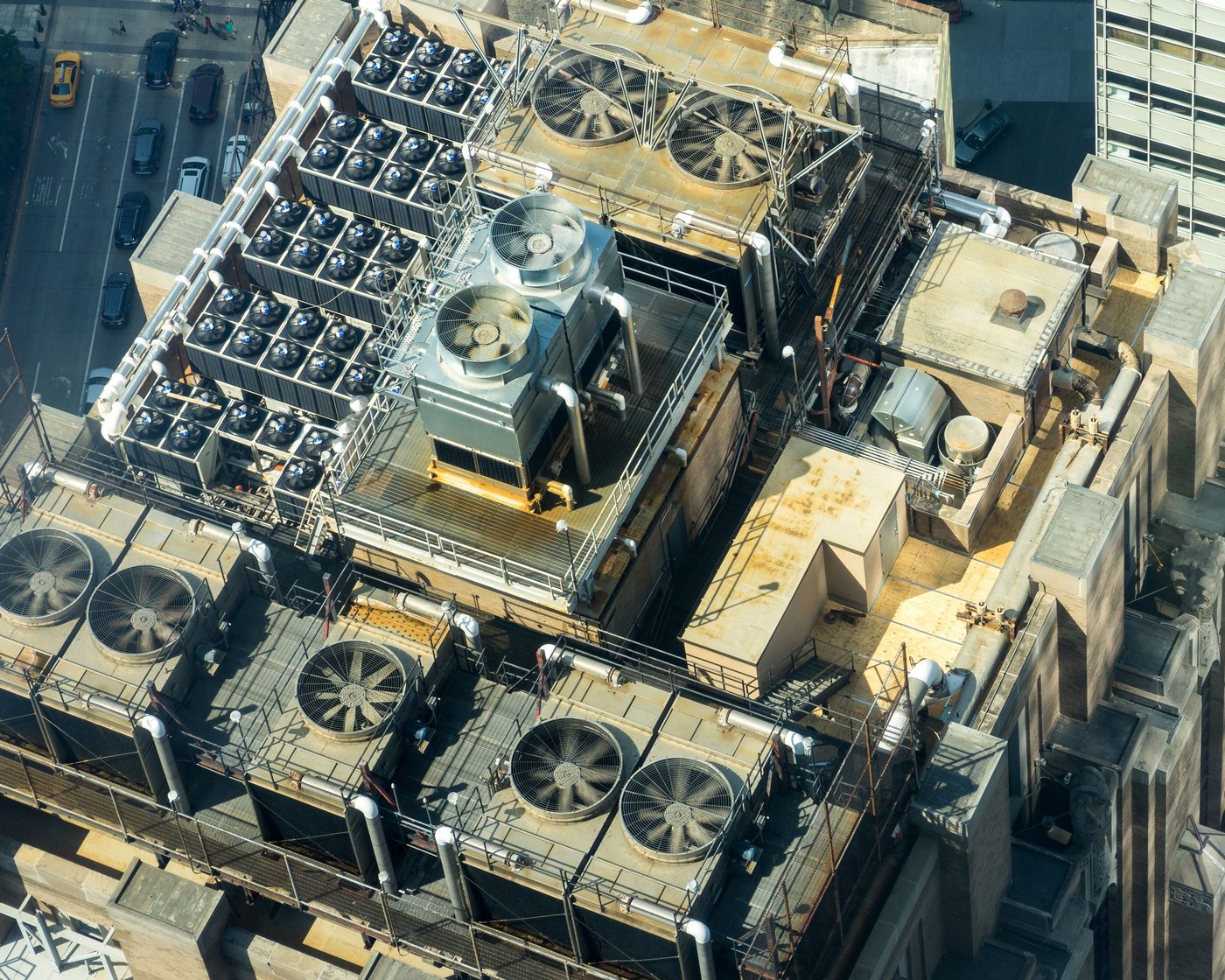
Paradise is not a city. It is an unincorporated town, the Strip runs through the middle of it, and the roofs here range from resort decks the size of city blocks down to the older apartment and rental property in the streets behind them. What they have in common is that somebody is always underneath.
Resort decks, rentals and everything between
A resort property rarely offers a plain area of covering to look at. High up, a tower roof is small and busy, shared between lift machinery, cooling plant and communications gear. Lower down, the wide deck over a casino floor or a lobby carries chillers, long duct runs, screening, the steel behind a sign and the extract serving kitchens that never close. Most properties hold several of these at different levels, finished in different years, and a report that runs them together is worthless to whoever has to pay for the work.
Behind that sit apartment buildings, condominiums and rental houses, older than the housing further out and largely owned by people who do not live in it. Those roofs mix low slope areas with tile or shingle, and they have usually been patched by a succession of owners rather than maintained by one.
Where a crowded roof gives itself away
Faults here cluster rather than spread. Anything that passes through the covering was cut and sealed by hand, and a roof carrying hundreds of curbs, supports, drain lines and conduits offers the same number of chances to let go. A unit working through the summer shakes its own curb, and the flashing lets go at the top bend before anything out in the open shows wear. A condensate line discharging onto the covering keeps one patch wet through months when the rest of the valley sees no water at all, which is why a stain can appear in a season with no weather in it.
Then there is who walks up there. Mechanical, electrical, telecom and sign crews are on these roofs all year, and every trip carries grit onto a surface that is softer for being hot. So the inspection begins at the plant, follows the paths worn between it and the hatch, checks the drains those paths cross, and finishes at the change of level where a lower roof dies into a taller wall, which absorbs movement from two structures at once and is the hardest place on the property to get to.
On the rental and condominium stock the emphasis shifts to age and to what earlier owners did. Coating over coating. Flashings caulked instead of rebuilt. Low slope areas above walkways and stairwells taking the runoff from everything above them through one outlet.
Arranging a visit around an operation
An inspection closes nothing. Nobody below has to move, no material arrives and no space goes out of use. What takes the time is the property’s own process, and on a resort that process is administrative rather than technical: an induction, a badge, proof of insurance, an escort and an assigned route to the hatch. None of it starts by itself. On a tenanted rental the equivalent is shorter but no less real. Somebody has to tell the resident, unlock a gate and put the dog inside.
Tell us the constraints when you book: event dates that shut an area, a tenant who works nights, a property being shown, a closing date if you are buying. We will work inside them.
Permitting belongs to the repair rather than to the survey, and here it is county business, because Paradise is a town rather than a city. Post usually arrives addressed to Las Vegas, which is where owners are caught out, so have the office settled from the address before anyone files anything. See what a commercial inspection covers, and send the property details on the booking form.
Common questions
A tenant reports a ceiling stain but there has been no rain. Is that still a roof problem?
It can be, and on a building here it often is, which is why a dry spell is not a reason to wait. Three sources produce a stain without weather.
- Rooftop equipment sheds condensate all summer, by design
- A line discharging onto the covering or disconnected lands water continuously
- A cooler runs water deliberately, through its pan, bleed and overflow
- Stored water in the assembly releases slowly, weeks after the storm
- Some stains are plumbing, not roof, which is worth establishing first
So we look from both sides where access allows: the stain inside, and the roof above and uphill of it, because water travels along the underside of a deck before it drops. Photograph the stain, leave it unpainted and note the date it appeared, since that narrows the search more than anything visible from the roof.
Our property is on the Strip. Does an inspection interrupt anything below?
Almost never, and where it might we agree it in advance rather than discover it on the day. An inspection puts one or two people on a roof with a camera and hand tools.
- Nothing is opened, no material delivered, no lift needed, no space closed
- Reaching the roof usually means the service side of the building
- A dock, a back corridor, a freight elevator and somebody from engineering
- Badges follow an induction and an insurance check, on their own timetable
So the lead time here is administrative rather than technical. Tell us who owns the approval if an area needs permission to work at height or sits under another department. And say early if the interior below a suspected leak must be seen, because a guest or gaming area takes far longer to arrange than the roof.
Does the inspection have to happen at night?
The inspection itself rarely does. Roof work on an occupied property often runs at night because of noise, odor and moving materials, and none of that applies to a survey.
- Daylight beats floodlight for a visual inspection
- An early start beats the afternoon in summer, for seeing and for safety
- Infrared moisture surveys are the exception, and they read after sunset
- So that element is scheduled separately from the daylight walk
We will say clearly which parts of the visit fall where. Beyond that, the calendar rather than the clock is the constraint in the convention corridor, because a roof above a hall hosting something may be closed to everybody whatever the hour. Send those dates with the booking and we will work inside them.
Kitchen exhaust discharges onto part of our roof. Is that area inspected differently?
Yes, and it is one of the first places we go on a property with food service. Grease laden air leaves the fan, lands on the covering and spreads downwind, and some membranes are degraded by it.
- So we ask what the covering is and how it is standing up
- Whether a sacrificial layer or grease containment was provided
- Whether it is being cleaned or simply accumulating
- A slick, discolored or softened surface is a finding, not a housekeeping note
Three things are recorded with it: the curb and flashing at a fan that vibrates constantly, the outlets downstream that foul faster than the rest of the roof, and the traffic that grinds grit into a softened surface. The report separates what needs a roofer from what needs a cleaning schedule. Much of the damage there is prevented by the second rather than repaired by the first.