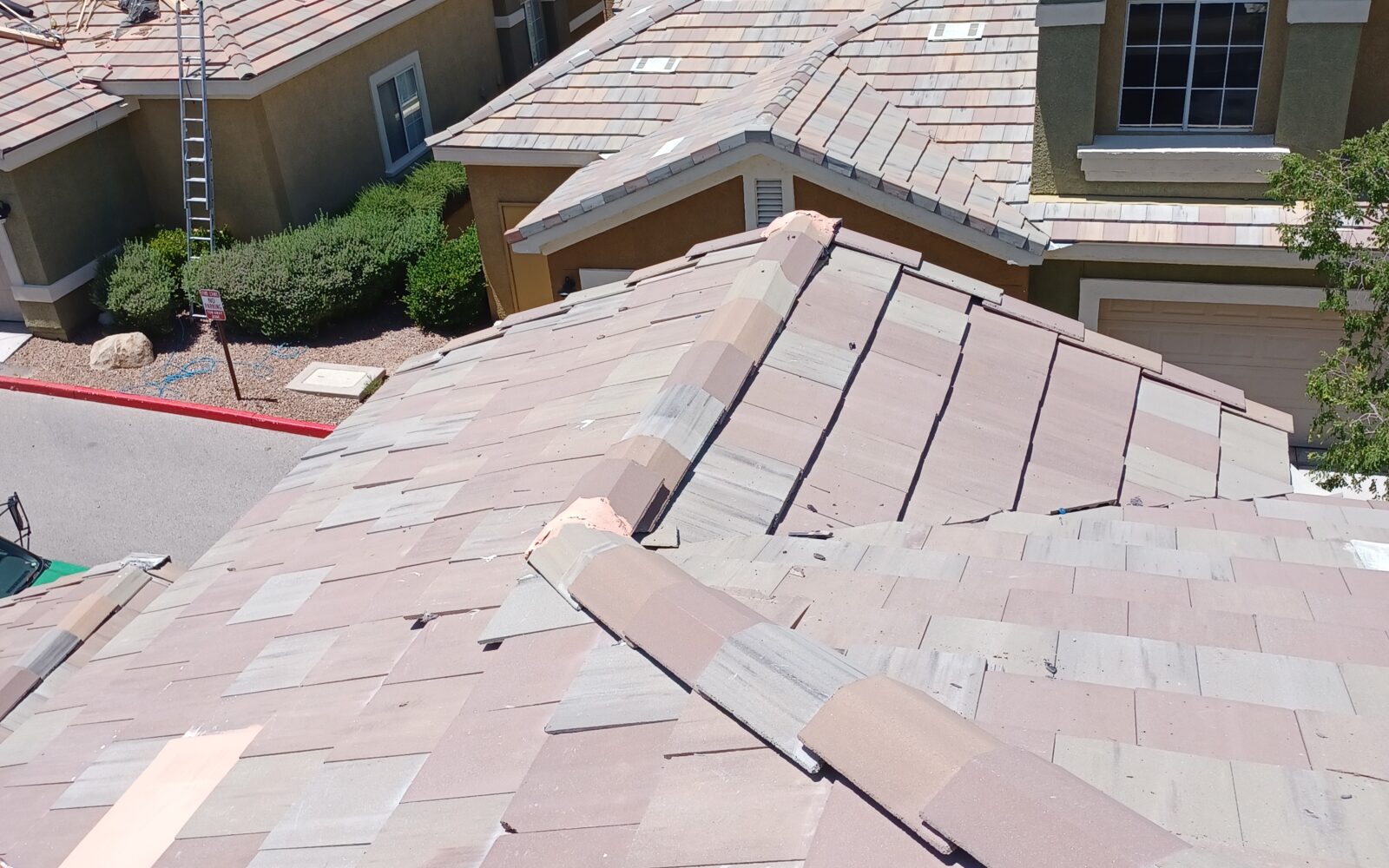
Residential roofing in Las Vegas is mostly underlayment work with tile handling attached. The concrete or clay tile on the roof is a weather shield and it lasts a very long time here. The layer beneath it carries whatever water gets past, and decades of sun and daily temperature swing make that layer brittle long before the tile shows anything at all.
Which is why Professional Roofing Services starts every residential job with a look rather than a number. A quote produced from the driveway is an estimate of an area. The useful question is which layer has failed, and the only way to answer it is to lift tiles and see.
The three jobs a valley house roof needs
| Repair | Lift and relay | Full replacement | |
|---|---|---|---|
| What it addresses | One detail or a small area | The underlayment across an elevation or the roof | Covering and underlayment together |
| Existing tile | Stays in place | Removed, stacked and reset | Replaced |
| When it fits | Underlayment sound elsewhere | Underlayment brittle, tile serviceable | Tile broken in quantity, or shingle at its end |
| Typical disruption | A day | A planned project in sections | A full reroof |
| What it buys | Stops this leak | Resets the layer that fails | A complete new roof assembly |
Most houses here move through that table in order over a long ownership. The decision point is what the sample lifts show, and it is worth getting that evidence before spending on the next individual repair.
Why the details matter more than the slopes
Houses do not leak in the middle of a tile field. They leak at valleys, where volume concentrates. At the junction with a wall or a chimney, where the upstand and counterflashing have to be built rather than sealed. At pipe penetrations, where the original collar has gone hard. At skylights. And at the transition between the tile and any flat section behind it.
That is where a quote earns its price or gives itself away. Ask which details are being reopened and rebuilt, rather than how many square feet are included. Roof repair in Las Vegas covers what fails at each of them, and a residential roof inspection is how the list gets made in the first place.
The flat sections nobody quotes
Almost every valley house with tile also has low slope roofing somewhere: over an addition, a patio cover, a porch or a mechanical area. It ages differently, it holds water where the tile sheds it, and it takes the discharge from the slopes above it.
Price the roof as one thing even when it is built from two systems. A relay on the tile that stops at the transition leaves the junction untouched, and that junction is where water has usually been getting in.
Timing the work around the season
Summer roofing here runs on a short productive day. Crews start at first light and follow the shade, which lengthens the calendar even when the work itself is straightforward, and the heat puts a real limit on what can be handled safely in the afternoon. Spring and autumn are the comfortable windows and they fill up quickly.
The more important point is sequencing. A roof is taken apart in sections sized so that each one can be made watertight before the crew leaves for the day, which is how a reroof runs safely through monsoon season without the house being exposed to a storm overnight. Ask any contractor how they phase the work and what happens if weather arrives midway, because the answer separates a planned job from a priced area.
What to settle before you accept a quote
- Which layer the price covers, in plain words.
- Which details are being rebuilt, named individually.
- The underlayment by specification, not by category.
- Tile matching, where replacement tile is needed and how it will be sourced.
- Found conditions, and how a change in price is agreed if the deck has been wet.
- The warranty, on material and on workmanship, each with a duration and what voids it.
Get all six in writing from every bidder and the quotes become comparable. Without them you are comparing totals for work that may not be the same work at all.
Where to start
Book a look at the roof. We walk every roof on the property, lift tiles at the leak and at sample points elsewhere, check the flat areas and the details, and come back with a written finding and photographs. From there you know whether you are buying a repair, a relay or a new roof, which is the one thing worth settling before anybody prices anything. Tile roofs in the valley covers the system most of this applies to.
Common questions
What roofing materials are used on Las Vegas houses?
Concrete tile covers most of the valley, with clay tile on older and higher end properties, asphalt shingle on a minority of homes, and low slope membrane or spray foam over additions, patio covers and flat sections. Many houses carry two of these at once.
- Concrete tile is the valley default by a wide margin
- Clay tile appears on older and custom properties
- Asphalt shingle is present but less common here
- Additions and patio covers are usually low slope
- Most roofs are a combination rather than one system
The combination is the part that catches people out. A tile roof with a flat section over the back of the house has two assemblies with different service lives, two sets of details, and a junction between them that has to be built correctly and is often the first thing to leak. When you are pricing work, make sure the quote covers every roof on the property rather than the main slopes, and that it names what happens at the transition.
Should a Las Vegas roof be replaced with the same material it has now?
Usually yes on tile, because the existing tile is normally still serviceable and reusing it is far cheaper than buying new. The real decision is rarely the covering at all. It is which underlayment goes beneath it, and that is where the longer lasting choice is made.
- Existing tile is reused where it survives handling
- The underlayment choice decides the next service life
- Changing system can affect weight and framing
- Association rules often govern appearance
- A shingle roof is a more open decision
Ask what underlayment is proposed and why, because the options differ considerably in how they handle sustained heat and how long they are expected to last under tile here. Ask for it by name and specification rather than by category. Changing the covering entirely is a bigger question: swapping tile for a lighter system or the reverse raises structural and appearance issues that need settling before anybody quotes, and a design review body may have a view.
How long does a residential reroof take on a valley house?
A lift and relay on an average house is usually a matter of days rather than weeks, and a straightforward shingle replacement is quicker. The schedule is set less by the roof than by the weather window, the material lead time and how much is found once the covering comes off.
- A lift and relay is measured in days on most houses
- Summer shifts start early and finish before the heat
- Material lead time can exceed the work itself
- Found conditions add time once the roof is open
- The roof is never left open going into a storm
What matters more than the total is how the work is sequenced. A roof is taken apart in sections sized so that each one can be made watertight before the crew leaves, which is how a job runs safely through monsoon season. Ask any contractor how they phase it and what happens if a storm arrives midway, because the answer tells you whether they have planned the job or simply priced the area.
Do we have to move out while the roof is being replaced?
No. Roof work on a house is carried out from outside and the family normally stays in place throughout. What it does affect is noise, dust in the attic, parking and anything stored directly under the roof deck, and all four are easier handled before the crew arrives.
- The work happens from outside the building
- Tile removal and fixing are genuinely loud
- Fine dust comes through an unsealed attic
- A container and a material route need parking space
- Cover anything stored in the attic beforehand
Plan around the noise rather than the access. Anybody working from home or sleeping during the day should expect to be disturbed through the removal and fixing stages, which are the loudest. Loose items in the attic are worth covering, pictures on walls below the roof occasionally need taking down, and a car parked under the work area needs moving. None of it is difficult, and all of it is easier to arrange before the first day than during it.
Is it worth replacing the underlayment before the roof actually leaks?
On an older tile roof, usually yes, and the reason is cost rather than caution. Once water is reaching the deck the job grows: wet decking, damaged insulation and interior repairs all get added to work that would otherwise have been a planned relay of the same roof.
- A planned relay costs less than one forced by a leak
- Water that reaches the deck adds structural repair
- Interior damage is rarely covered by wear and tear
- A dry roof can be phased across elevations
- Sample lifts show how much life is left
The way to decide is to lift tiles at several points and look rather than to go by the age on a document. If the underlayment is still flexible, you have time and the right answer is to keep an eye on it. If it is brittle wherever a tile comes up, the roof is on borrowed time and a relay can be planned, budgeted and phased on your schedule instead of in the middle of a monsoon. [What the heat does to a roof here](/articles/las-vegas-heat-roof-damage/) covers why that layer ages the way it does.